
Everyone at the Barbecue Had an Opinion About Our Electric Car, So I Made the House Keep Receipts
Three months, 6,792 km, every kilowatt-hour logged by the house and every fast charge dug out of my inbox. The EV did the same driving as the diesel Hilux for about a sixth of the price, and the only expensive part was me. Full config included.
There is a particular look a person gets at a barbecue when you mention you've bought an electric car. It's half pity, half the look you'd give someone who's just announced they're taking up the bagpipes. Then come the questions, delivered as statements. "Costs a fortune to charge, but." "You'll be paying for it in your power bill, mate." "Wait till you see what the fast chargers cost."
In late July the business bought a Kia EV9. It came with 25,800 km already on the clock, three rows of seats, and an ego the size of a small shed. The Hilux is still in the driveway, judging it.
The problem with the barbecue debate is that nobody has any actual numbers. Including me. I had a feeling it was cheaper. A feeling is not a receipt. So I did what any reasonable person would do: I made the house write everything down, then went through my email for the rest.
The ledger
My house is already a bit of a snitch. Home Assistant logs every sensor into InfluxDB, so the data was mostly sitting there waiting to be asked the right question. Four sources:
- The charger circuit. The car charges from a standard WiFi-enabled 15 A portable charger on its own circuit, behind a metered DIN breaker. Every watt that goes into the car from the house goes through that meter.
- The grid meter. A Shelly EM3 on the main board tells me, minute by minute, whether the house is importing from the grid or exporting solar. That's how I split each kilowatt-hour into "came off the roof" and "came off the grid." For context, the roof is a modest 6 kW array, and there's no home battery at this stage.
- The tariff clock. I'm on a time-of-use EV plan. Super off-peak midnight to 6am is 8c/kWh. The 4–8pm peak is 39.9c. Shoulder is 30c. Solar I export earns a heroic 2c. Every minute of charging gets tagged with the rate that applied.
- The odometer. The car reports it. That gives me kilometres.
I did not use the car's own "average energy consumption" figure. According to Kia's app, the car used 8.7 kWh over 90 days. Over the same period I drove six and a half thousand kilometres. Either it runs on smugness or that number is decorative. I'm going with decorative.
The scoreboard
From the first data point on 1 August to 7 November: 6,792 km.
| kWh | Cost | |
|---|---|---|
| Home charging (metered, 21% of it from solar) | 1,439 | $170.74 |
| Home charging, first week before the meter went in (estimated) | ~57 | ~$17 |
| DC fast charges (5, at about 70c/kWh) | ~166 | ~$116 |
| EV9 total | ~1,662 | ~$303 |
Now the Hilux doing the same 6,792 km. I've assumed 10 L/100 km, which is a fair real-world number for a 2.8 diesel 4×4 that spends its life with stuff in the tray, and $2.60/L, a middle-of-the-road figure for Brisbane diesel over these three months (it was closer to $2.78 by late October).
| Same 6,792 km | Cost | Per km |
|---|---|---|
| EV9 | $303 | 4.5c |
| Hilux, 679 L of diesel | $1,766 | 26c |
That's $1,463 saved in a bit over three months, or about 83% cheaper per kilometre. The car uses about 22 kWh per 100 km, which for a three-row people-mover the size of a small house is entirely reasonable.
Where the money actually goes
Here's the bit the barbecue gets wrong. Charging an EV isn't one price. It's whatever the clock says when the plug goes in.
| Window | Rate | kWh into the car |
|---|---|---|
| Super off-peak (00:00–06:00) | 8c | 779 |
| Solar surplus (exported otherwise) | 2c | 308 |
| Shoulder | 30c | 202 |
| Off-peak (06–07, 22–24) | 25.6c | 83 |
| Peak (4–8pm weekdays) | 39.9c | 66 |
Three-quarters of the home charging came from either the 8c window or the roof. That's why home charging averaged 12.5c/kWh all-in. And that's off a 6 kW array with no battery, so the sun only helps when the car happens to be parked at home in daylight. The same energy at a flat 30c tariff would have cost about $430 instead of $170.
And the fast chargers? They were 10% of the energy and 38% of the cost. At 70c a kilowatt-hour, a fast charge isn't a disaster, it's just the most expensive way to own the car. Still about a third cheaper per kilometre than diesel, mind you. But a road-trip luxury, not a habit.
The car was never the expensive part. The expensive part is plugging it in at 5:30pm because you're tired and it's right there.
Making the house do the boring bit
You can set a charging schedule in the car's app. The problem is that a schedule doesn't know when the sun is out, doesn't know whether the house is about to import, and absolutely doesn't know that I'm going to forget it exists and override it.
So Home Assistant runs the charger. And here's the bit I want you to notice: apart from Home Assistant itself, the whole thing hangs off two pieces of fairly ordinary hardware. A standard WiFi-enabled portable EVSE, the plug-in kind with an app, not a fancy smart wallbox. And a Shelly clamp meter on the grid feed. That's it. No smart wallbox, no inverter integration, no home battery, no subscription. If you've already got Home Assistant, the hardware bill for this is "a charger you were going to buy anyway" plus "a clamp meter."
One controller decides "should the car be charging right now?" every two minutes, and a second, faster loop adjusts the charging current every 15 seconds to soak up whatever the roof is exporting. The decision is basically four lines:
variables:
  in_offpeak: "{{ is_state('binary_sensor.ev_super_off_peak_window','on') }}"
  manual: "{{ is_state('input_boolean.ev_charge_now','on') }}"
  day: "{{ is_state('sun.sun','above_horizon') }}"
  cheap: "{{ manual or in_offpeak }}"
  # power available to the car = its current draw + what we export - what we import
  avail_w: "{{ ev_power + export_w - import_w }}"
  raw_amps: "{{ (avail_w / volts) | round(1) }}"
  # solar surplus available AND the EV is top of the energy-priority order
  solar_start: "{{ day and (not charging_now) and export_w >= surplus_w
                   and is_state('binary_sensor.ev_solar_clear','on') }}"
  # keep going while we can still ramp DOWN - a passing cloud reduces the amps,
  # it doesn't kill the session
  solar_keep: "{{ day and charging_now and (raw_amps > min_a or import_w < stop_w) }}"
  want_on: "{{ plugged and below_target and (cheap or solar_start or solar_keep) }}"
Charge if it's cheap, or if the sun is paying for it. Otherwise, don't. The car stops itself at 80% on a normal day, or 100% when I flip a "road trip tomorrow" switch.
Here's what that looks like on a good day.
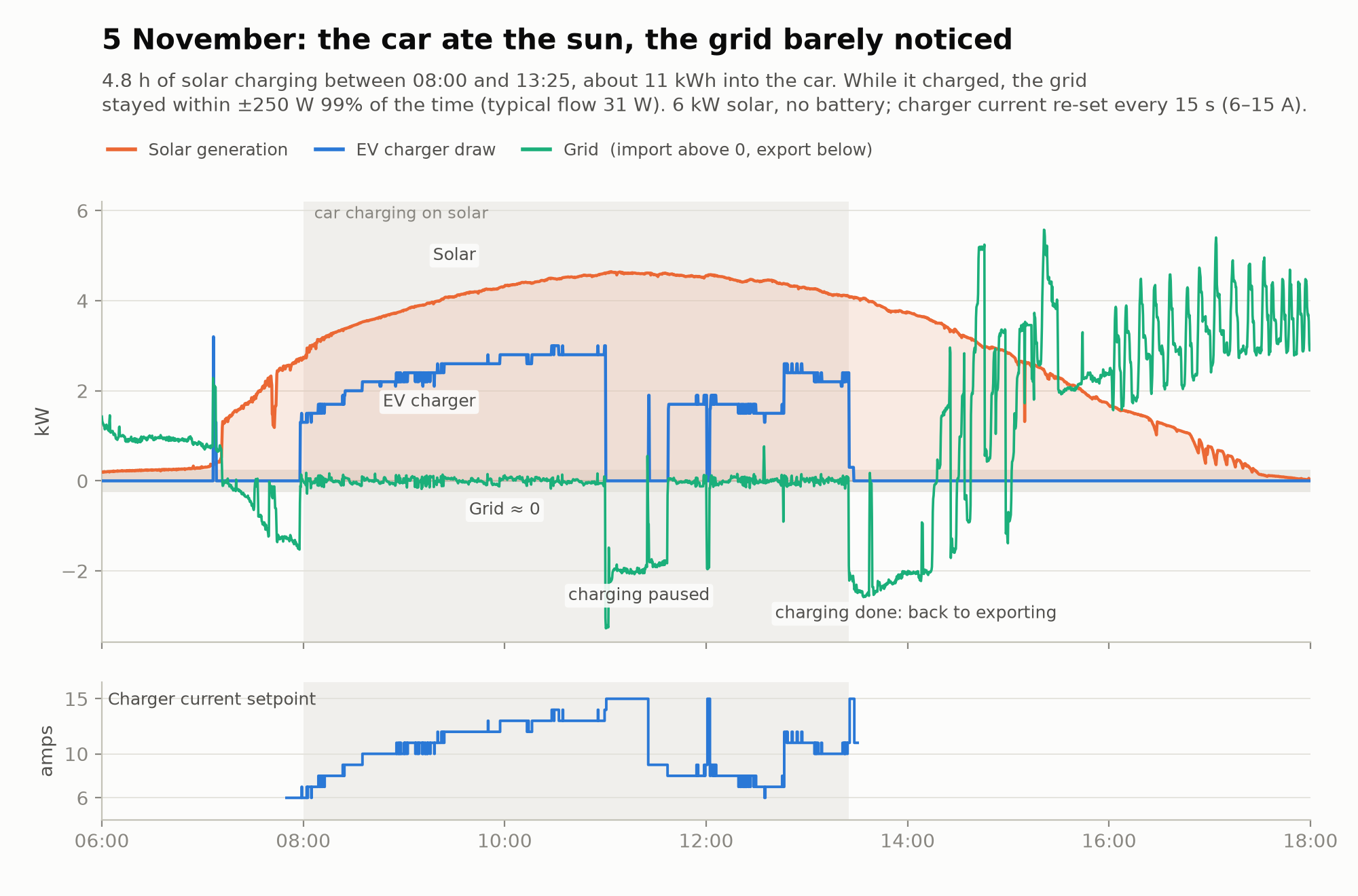
The orange curve is the roof. The blue line is the car, stepping up and down an amp at a time as the sun climbs and the rest of the house switches things on and off. The bottom panel is the current dial itself, nudged every 15 seconds. The green line is the grid, and the whole point is that it barely moves. On 5 November it stayed within 250 W of zero for 99% of nearly five hours of charging. One amp is about 240 W, so that's the house holding itself to within about one notch of the dial, all morning, without anyone touching anything.
The one big dip in the middle is the charging pausing for forty minutes. The dial went to maximum and the car drew nothing, so the roof went straight back to exporting at 2c until charging picked up again.
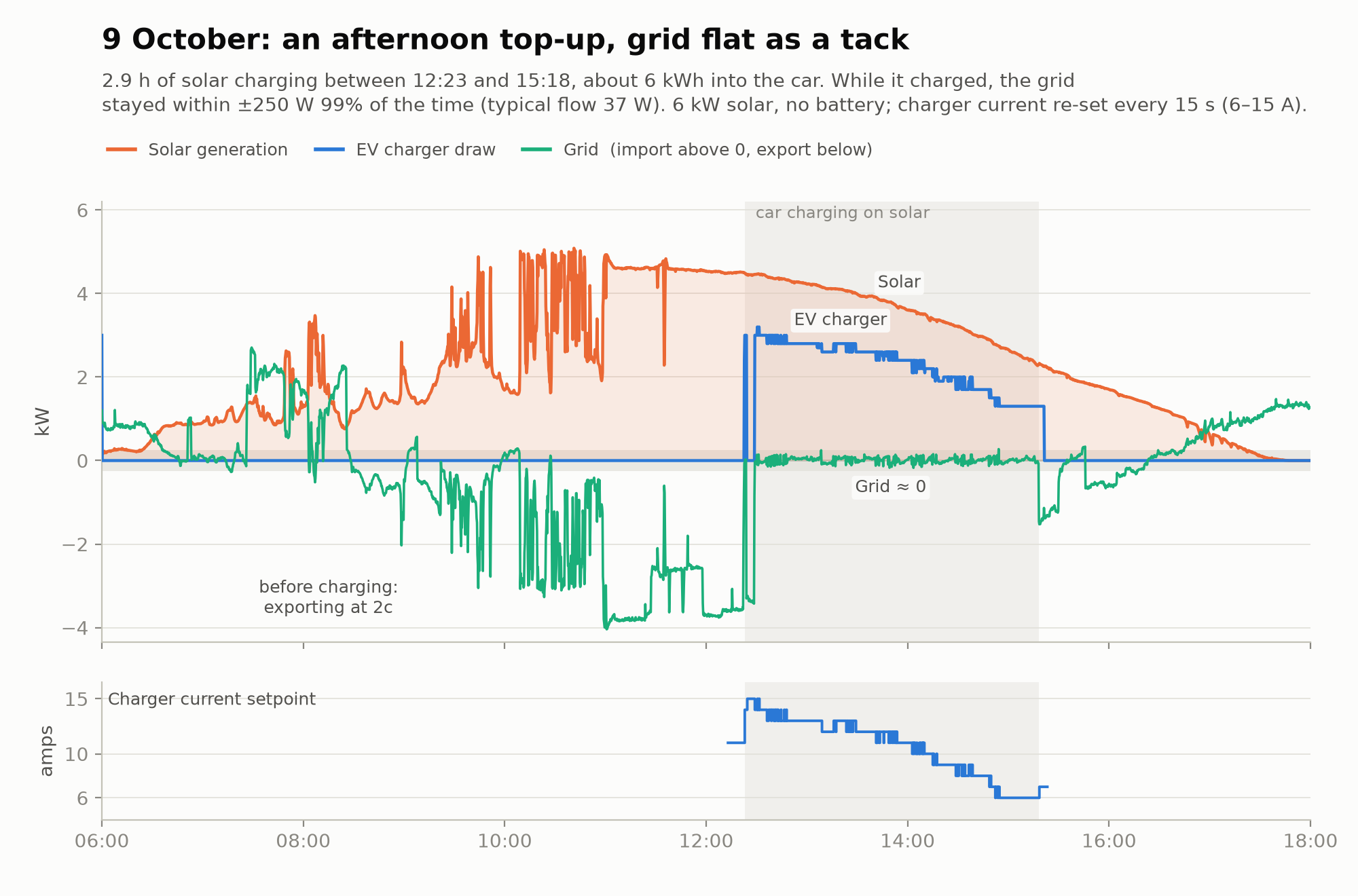
On 9 October it's even clearer. All morning the house exported 3–4 kW to the grid at 2c a unit, because nothing was plugged in. The car arrives just after midday, and the green line snaps to zero and stays there for three hours while the dial walks the current down from 15 A to 6 A to follow the sun across the sky.
When the car's not hungry, the sun goes to the ice bath and the pool
Here's the catch with a car that has a day job: it's often not home when the sun is. And when it is home, it's sometimes already full. Every kilowatt-hour the roof makes that nothing uses goes out the door for 2c. That offends me on a personal level.
So the EV isn't the only thing eating the sun. There are two other loads that have to run anyway:
- The ice bath. A small chiller of about 300 W. It chills on spare solar during the day, then tops up in the 8c window overnight so it's cold for a 5:30am start. (That one got its own post: I Taught My Ice Bath to Read the Weather Forecast So It Would Be Cold at 5:30am.)
- The pool. The filter pump has to run a set number of hours every day regardless. The house tries to get those hours done on spare solar, and anything it can't finish in daylight gets made up in the 8c window overnight. The chlorinator just follows the pump.
They take turns from a priority list, a single dropdown on the dashboard. By default it's car first, then ice bath, then pool. Each one is only allowed to start on solar when nothing above it on the list still wants it. And it's layered: once the car is pinned at its maximum 15 A and there's still sun left over, the ice bath can have the leftovers, and then the pool.
The order isn't random. The car is the only one of the three that can turn its appetite up and down a notch at a time, so it sits on top and soaks up the wobbly, cloud-dependent part of the surplus. The ice bath and pool are fixed lumps that are either on or off, so they take the big steady chunks underneath. If I need the pool done first on a hot weekend, I change the dropdown. Nobody edits YAML.
In the spirit of honesty: the original "car goes first" rule quietly stopped working for a couple of days this month. A software update renamed one of the car's sensors, the pool and ice bath were still asking the old, now-dead one whether the car was plugged in, and they decided it never was. No error, no alert, just the pool happily taking the sun the car should have had. The priority list replaced that rule, and it reads the sensor that actually exists.
The night it cost me peak rates
The first day I let it run unattended, it started charging on solar, exactly as designed. Then the sun went down. Then the house started importing. Then peak started. And the car just... kept charging.
The stop rule needed to know how long it had been since the charger last switched, so it didn't flap on and off. That calculation subtracted a timezone-naive time from a timezone-aware one, which Home Assistant's template engine refuses to do. The error was silent. The stop branch never matched. The charger never stopped.
The fix is one line, and it's still in the config with a comment so I never do it again:
# tz-safe elapsed seconds since last on/off (as_timestamp avoids the naive/aware datetime
# subtraction bug that previously errored the STOP branch -> charger never turned off ->
# peak grid charging).
since_change: "{{ as_timestamp(now()) - as_timestamp(states('input_datetime.ev_charge_last_change'), 0) }}"
I also added a hard rule: if it's dark, or it's peak, stop now, no waiting for the timer. Belt, braces, and a second belt.
Has it got any better?
This was the question I actually cared about. The first couple of months included the new-car week, a few longer trips, and the automation learning to walk. So I compared the last 30 days with everything before it.
| Before (1 Aug–8 Oct) | Last 30 days | |
|---|---|---|
| Distance | 5,056 km | 1,737 km |
| DC fast charges | 5 | 0 |
| Home cost per kWh | 13.2c | 11.0c |
| Share from solar | 19% | 24% |
| Share at shoulder/peak | 19% | 15% |
| Energy use | 22.2 kWh/100 km | 21.2 kWh/100 km |
| All-in cost per km | 5.1c | 2.7c |
| What the Hilux would have cost | $1,314 | $452 |
| What the EV cost | $256 | $47 |
Yes, it's improved. Cost per kilometre has nearly halved. In fairness to the barbecue, most of that is simply that I didn't fast-charge at all in the last 30 days. But the home charging itself got 17% cheaper per kilowatt-hour as well, with more sun and less peak.
Month by month (home charging only):
| Month | kWh | Cost | c/kWh | Solar | Peak kWh |
|---|---|---|---|---|---|
| August (from the 7th) | 554 | $88.54 | 16.0 | 20% | 46 |
| September | 345 | $25.23 | 7.3 | 20% | 0 |
| October | 475 | $54.29 | 11.4 | 18% | 20 |
| November (first week) | 65 | $2.68 | 4.1 | 62% | 0 |
August was before the automation existed. That's a car doing what every EV does out of the box: you plug in when you get home and it charges straight through the most expensive four hours of the day. September is what it looks like when you leave the house alone. Zero peak.
October went backwards, and I went looking for who to blame. The logs are very clear. Every peak-rate kilowatt-hour in October happened on an evening when someone pressed the Charge Now button. That someone was me. Three times.
October also had a fun one where the charger went "unavailable" after I re-paired it in its app, and a separate stretch where the car politely refused to AC-charge at all, because a toggle in the Kia app had been switched off. The house kept asking the car to charge, the car kept saying no, nobody told me. There's now an alert for when the charger drops off the network. The car-side toggle is still on the to-do list.
November so far is 62% solar at 4c a kilowatt-hour. It's one week, and the sun's coming. Don't get excited. I'm a little excited.
Projecting to the end of the financial year
There are 235 days between now and 30 June. The car has averaged 70 km a day since it arrived, and 58 a day over the last month. I'll use the October-style home charging rate (2.7c/km, which ignores the summer sun, so it's on the gloomy side), and allow one fast charge a month at about $30.
| Pace | FY kilometres | EV9 | Hilux | Saved |
|---|---|---|---|---|
| Average so far (70 km/day) | ~23,200 | ~$980 | ~$6,040 | ~$5,060 |
| Last month's pace (58 km/day) | ~20,400 | ~$900 | ~$5,310 | ~$4,410 |
Every 40c the diesel price moves shifts the Hilux column by about $900 over the year. Any more fast charging than one a month pushes the EV column up. Either way, the gap is in the thousands, not the tens.
The rules I gave it
- Never charge from the grid outside the 8c window on its own. If the car needs it in the evening, a human presses a button and accepts the bill.
- Solar first, but ramp, don't hard-stop. A cloud should turn the amps down, not end the session. Only sustained low solar at the minimum current stops it.
- Stop immediately at night or in peak. No waiting for a timer. That's how the peak-rate bug happened.
- Spare sun goes down a list. Car first, then the ice bath, then the pool, and the order is a dropdown, not code.
- 80% on a normal day, 100% only when asked. The battery doesn't need to be full to go to the shops.
- Measure at the wall, not in the car. The car's own consumption numbers are fiction. The breaker meter isn't.
The honest bit
This is energy only. No rego, insurance, servicing, tyres, or the small matter of what the car cost in the first place. That's a different, longer, sadder spreadsheet.
The Hilux side is an estimate: 10 L/100 km and $2.60/L. If yours does 8.5 L/100 km on the highway, good for you, the gap shrinks a bit. If yours tows a boat, it grows.
About 57 kWh of home charging from the first week is estimated from the battery percentage, because the meter wasn't in yet.
The charger runs on Tuya's local protocol through a community integration. The car talks to Home Assistant through an unofficial integration that uses Kia's cloud. Neither is supported by anyone who'd answer the phone. This is personal-use tinkering, and I have nothing but respect for the people who maintain those integrations for free.
There's no home battery here, just a 6 kW array. The car can only eat solar while it's parked at home during the day, which for a car whose day job is driving people around isn't as often as I'd like. The 8c overnight window does the heavy lifting. A battery would let the roof fill it during the day and the car drain it at night, but that's a different post and a much bigger number.
And the 2c feed-in tariff is doing a lot of quiet work here. Solar going into the car instead of out to the grid is the best deal in this whole post, mostly because the alternative is basically giving it away.
The EV9 earns its keep as the DyComDrive car: door-to-door runs to hospital appointments and the airport, where the driver waits and brings you home. Quiet, smooth, and now with the receipts to prove it does the job for about a sixth of what the Hilux would cost. The Hilux remains in the driveway for anything involving a trailer or a dog that has rolled in something.
The barbecue has moved on to arguing about something else. I've printed the table anyway.
Disclaimer: these are one household's numbers, on one tariff, with one particular roof and one particular person pressing "Charge Now" when they shouldn't. Your mileage, literally, will vary. Electrical work on a charger circuit is a job for a licensed electrician, not a person with a YouTube tab open.
Get one of these — and a working automation — each week.
The builds, the bugs, and the YAML. No fluff.
Don't fancy the DIY?
Get Dycom Automation to do it properly.
Reading YAML isn't everyone's idea of a good night in. Dycom Automation — the grown-up, properly-insured version of all this — will design, install and tune your whole smart home for you. Same ruthless automations, none of the swearing.
Get it done by Dycom Automation →